


Featuring club classics, one-hit wonders and terrace anthems, here is our Liszt of classical music-inspired singles
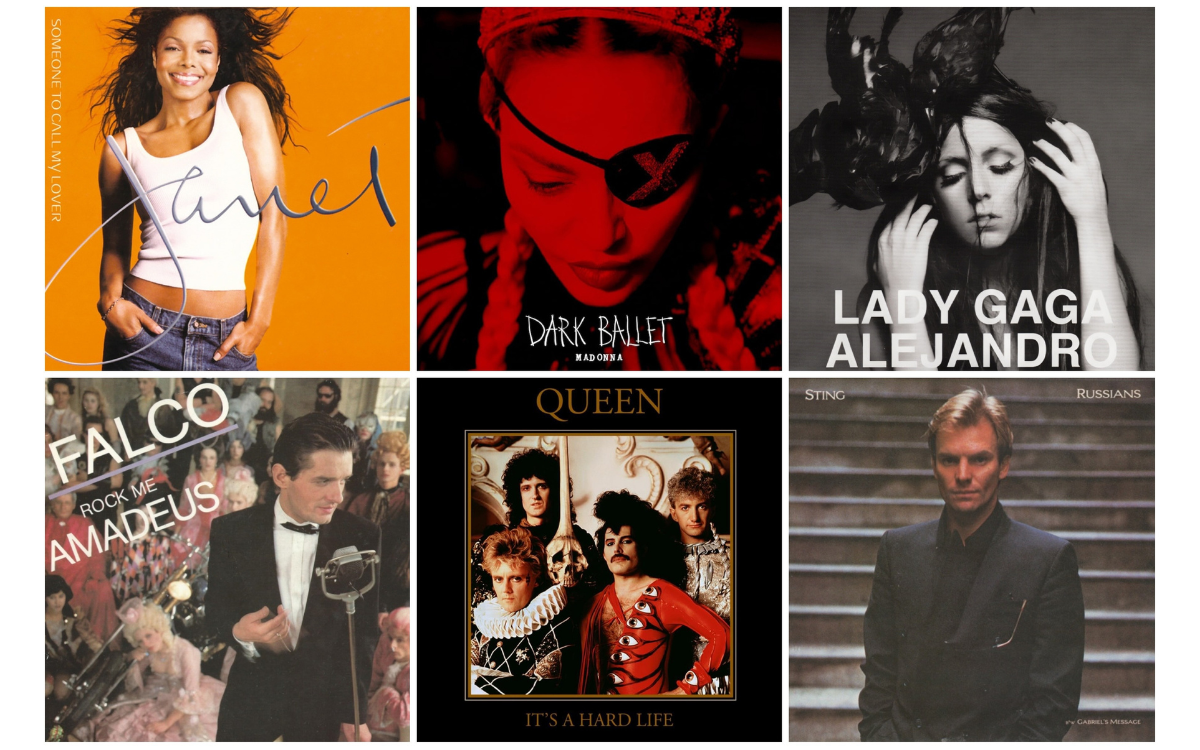
From Janet Jackson, Madonna and Lady Gaga to Falco, Queen and Sting, in the genre-spanning world of pop and rock, many acts were hooked on classics – here are our Top 20 classical-influenced pop…
Words by Barry Page
Musical inspiration doesn’t come out of thin air, and behind every hit single there’s some form of creative stimulus. Ingrained since childhood and entwined in our cultural fabric, classical music has proven to be highly influential over the years.
In the pop world, while many musicians innovatively applied formal training to their art, there were some who directly lifted melodies from renowned composers, creating memorable pieces of music in a variety of creative ways.
Featuring club classics, one-hit wonders and terrace anthems, here is our Liszt of classical music-inspired singles, which we hope isn’t more than you can Handel.

20 DNA – La Serenissima (1990)
The remix and production duo of Nick Batt and Neal Slateford scored a huge hit with their brilliant dance makeover of Suzanne Vega’s a cappella single, Tom’s Diner. For the follow-up, they turned to the baroque pop of Italian chamber orchestra Rondò Veneziano, transforming their best known song La Serenissima – recognisable as the theme to BBC’s Hospital Watch – into a veritable club favourite. Batt later went on to work with Goldfrapp, while Slateford co-founded sex toy company Lovehoney.

19 Sky – Toccata (1980)
A prog rock supergroup of sorts, Sky’s impressive line-up included Curved Air’s Francis Monkman, session bassist Herbie Flowers, and celebrated classical guitarist John Williams, whose take on Stanley Myers’ Cavatina had doubled up as the hit theme to The Deer Hunter. Famed for mixing original material with interpretations of classical works, Sky recorded Bach’s Toccata And Fugue In D Minor at the suggestion of Monkman (who’d heard it in the movie, Rollerball), and scored a major UK hit.

18 Public Image Ltd – Death Disco (1979)
This is not a love song, rather a harrowing exercise in catharsis, with John Lydon channelling the pain of watching his mother slowly die from cancer into song (“Saw it in her eyes/ Choking on a bed/ Flowers rotting dead”). “I played it to her just before she died and she was very happy,” he told the NME. In a case of cryptomnesia, PiL’s guitarist Keith Levene incorporated the leitmotif from Tchaikovsky’s ballet, Swan Lake, as covered by Madness on debut LP One Step Beyond the same year.

17 Billy Joel – This Night (1984)
Taken from multi-platinum album An Innocent Man, this ballad paid homage to the doo-wop sounds of Little Anthony And The Imperials (of Tears On My Pillow fame), but its soaring chorus melody was lifted directly from the second movement of Beethoven’s Sonata Pathétique, a popular piece previously utilised in opera singer Louise Tucker’s synth-pop hit, Midnight Blue. The Piano Man cited Beethoven as a major musical influence, even referring to him as “God” in an interview with Steinway & Sons in 2019.

16 Janet Jackson – Someone To Call My Lover (2001)
Among the many musicians inspired by French composer Erik Satie was Gary Numan, who covered the first of his Gymnopédies for a B-side. After seeing a TV ad during her youth, the same melody had lodged inside Janet Jackson’s head, but it would be years before she realised what it was. Enthused, producers Jam & Lewis included it as a melodic flourish in this hit single, which also sampled the guitar riff from America’s Ventura Highway.

15 Lady Gaga – Alejandro (2010)
Exemplifying Lady Gaga’s appreciation for classical music, the video of Bad Romance opened with a section from Bach’s Fugue In B Minor, while the intro of Alejandro included the main melody from Vittorio Monti’s Csárdás. She reasoned in a recent interview with YouTube chat show Hot Ones that the work of Beethoven and Bach was structurally similar to pop music, both in terms of its pacing and expression. “It taught me how to think about where to put the drama in a pop song,” she said.

14 Queen – It’s A Hard Life (1984)
Following the divisive disco detour of 1982’s Hot Space, Queen got back to basics on their 11th studio album, The Works. But while the epic synth-pop of Radio Ga Ga suggested that they weren’t quite ready to reinstate their ‘no synthesizers!’ policy, Tear It Upand Hammer To Fall certainly restored their hard rock credentials. It’s A Hard Life reaffirmed Freddie Mercury’s classical influences, its bombastic intro based on the rousing aria Vesti la Giubba from Pagliacci by Ruggero Leoncavallo.

13 Laurie Anderson – O Superman (1981)
Well ahead of its time, this divisive novelty single from performance artist Laurie Anderson – cut at 33RPM to get in all eight minutes and 21 seconds – took its musical cue from Act 3 of Jules Massenet’s 1885 opera, Le Cid, while its lyrical inspiration was the ill-fated Iran hostage crisis. “We were left with dead bodies, a pile of burning debris and the hostages nowhere to be seen,” she told The Guardian. “So I thought I’d write a song about all that.” Endorsed by John Peel, it peaked at No.2 in the UK.

12 Strawberry Switchblade – Since Yesterday (1984)
Addressing the emotional impact of an impending nuclear attack, this memorable hit suggested there was much more to the Scottish duo of Rose McDowall and Jill Bryson than their pretty bows and polka-dot outfits. Stemming from a dreamy slice of indie pop titled Dance, its opening fanfare arrived courtesy of the third movement of Jean Sibelius’ Symphony No. 5, a motif also recognisable from the coda of Beach Boys pastiche Beach Baby, a hit for The First Class in 1974.

11 William Orbit – Barber’s Adagio For Strings (1999)
While much classical music is in the public domain and therefore not subject to copyright laws, William Orbit had to withdraw Pieces In A Modern Style in 1995 following reported objections from Estonian composer Arvo Pärt. But with his stock significantly raised following his work on Madonna’s Ray Of Light LP, Orbit was given the platform to release a reconfigured version four years later, boosted by Ferry Corsten’s floor-filling remix of Samuel Barber’s Adagio For Strings.

10 Madonna – Dark Ballet (2019)
Madonna in full-on bonkers mode, this deceptive track begins as a generic piano-based ballad with treated vocals, before evolving into an “apocalyptic frenzy” (her words), set to Dance Of The Reed Pipes from Tchaikovsky’s Nutcracker Suite. As she told Mojo magazine, the lyrics were influenced by the plight of doomed heroine Joan of Arc: “I can relate to her because I do fight for what I believe in. And when you fight for what you believe in, there’s always going to be a punishment waiting for you.”

09 Passengers – Miss Sarajevo (1995)
The only single to be lifted from an experimental album of (mostly) imaginary movie soundtrack pieces by U2 and Brian Eno, this moving song – inspired by a beauty pageant in war-torn Bosnia – featured the talents of Italian tenor and “extra passenger” Luciano Pavarotti, who’d ostensibly nagged Bono into collaborating. The single peaked at No.6 in the UK and is still a band favourite. “I always liked it at the time,” The Edge told Billboard, “but it has really stood the test of time.”

08 The Farm – All Together Now (1990)
For the follow-up to Groovy Train, The Farm dusted off an old song, No Man’s Land, inspired by singer Peter Hooton’s interest in the World War I. “I chanced upon an article about the unofficial truce in 1914, when British and German troops came out of the trenches to play football with each other for Christmas,” he explained to The Guardian. The use of Pachelbel’s Canon’s stirring melody lent the future terrace anthem emotional gravitas, resulting in a Top 5 hit.

07 Falco – Rock Me Amadeus (1985)
Falco took the inspiration for this rousing German-language global chart-topper from an epic 1984 biopic of compatriot Mozart, which charted the colourful career of the prodigiously talented composer. Co-written by Dutch brothers Rob and Ferdi Bolland (the team behind the original version of Status Quo hit In The Army Now), the song touched upon Mozart’s financial struggles in Vienna, but ultimately depicted him as the flamboyant rock’n’roll superstar of the post-Baroque era.

06 Sting – Russians (1985)
Written at the height of Cold War paranoia, Sting took the initial inspiration for this chilling single from watching Russian children’s TV shows via a satellite receiver at Colombia University, as well as his son’s genuine fears about a nuclear holocaust (“How can I save my little boy/ From Oppenheimer’s deadly toy?”). Sting utilised the ‘Romance’ theme from Russian composer Sergei Prokofiev’s Lieutenant Kijé suite to great effect, and in light of recent East-West tensions its anti-war sentiments are sadly still relevant.

05 Enigma – Sadeness (Part I) (1990)
The brainchild of classically trained pianist Michael Cretu, Enigma made an immediate impact with this global smash which set Gregorian voices and then-wife Sandra’s sensual whispers to a Soul II Soul beat. “This is music that is different from any other available at the moment. I think people have responded to that,” Cretu told Billboard. Their sound piqued the interest of OMD’s Andy McCluskey, who fused contemporary beats with choral music on tracks such as Vox Humana and Agnus Dei.

04 Pet Shop Boys – Love Is A Bourgeois Construct (2013)
The melodic concept for this late period classic came from the Henry Purcell-inspired Michael Nyman piece Chasing Sheep Is Best Left To Shepherds, which Chris Lowe regularly listened to on the train. For the tragicomic lyrics, Neil Tennant envisaged its protagonist as a wealthy city worker whose so-called bourgeois life is rendered pointless after his partner has left him. “He’s totally pathetic because he’s expecting her to come back,” the singer explained on the duo’s website.

03 Freddie Mercury & Montserrat Caballé – Barcelona (1987)
Passionate opera fan Freddie Mercury was enchanted by Barcelona-born soprano Montserrat Caballé, and an enthusiastic response to the question ‘who had the best voice in the world?’ posed by Spanish media set in motion one of the great genre-crossing collaborations. Despite Mercury’s reservations about their contrasting vocal styles, the duo’s chemistry was immediate, and their voices blended beautifully, particularly on this anthemic hit single.

02 Malcolm McLaren – Madam Butterfly (Un Bel Dì Vedremo) (1984)
Having successfully embraced world music and hip-hop on the Trevor Horn-helmed Duck Rock LP, Malcolm McLaren next turned his attention to the world of opera, lending his inimitable vocals to an album of contemporary pop based around the works of Puccini and Bizet. An impassioned take on the former’s Madama Butterfly was the standout, and its epic Stephen Hague production attracted a number of admirers, including New Order, OMD and Pet Shop Boys.

01 Ultravox – Vienna (1981)
A veritable child prodigy, Billy Currie was a proficient violinist at school, before switching to viola at the Huddersfield School of Music. Tchaikovsky’s Violin Concerto and Mendelssohn’s Italian Symphony were personal favourites, but modernist composers such as Arnold Schoenberg, Edgard Varèse and Béla Bartók would also prove influential.
A career as a classical musician beckoned, but he bravely turned down the Royal Academy of Music in London to expand his musical horizons, and his classical training wouldn’t really come to the fore until fourth Ultravox studio album Vienna, in particular its epic, titular centrepiece.
“I said to the guys I was keen to do something that sounded like the late-19th-century romantics, like Grieg and Elgar,” he later told The Guardian.
Incorporating classical influences gave Ultravox an immediate advantage over their contemporaries, whom they were keen to distance themselves from. Instrumental in developing what new frontman Midge Ure described as their mid-European sound was returning producer – and krautrock legend – Conny Plank, who introduced Currie to the work of German composer Max Reger, resulting in the classic single’s haunting solo.
There was certainly nothing like Vienna in the UK charts at the time. However, releasing it during the post-Christmas lull proved to be a mistake, denying the band a deserved chart-topper as a certain novelty record by Joe Dolce, Shaddap You Face, hit No.1.
Stream Ultravox here
Read More: Top 20 80s pop instrumentals
Classic Pop may earn commission from the links on this page, but we only feature products we think you will enjoy.